By Judicaël Régis KEMA KEMA & Christy Lyonnella NKOLLO ETOMBET – Aquatic Species NGO Communication / 11 December 2025
As the global biodiversity crisis worsens, with an average decline of 69% in wildlife populations between 1970 and 2018 (WWF, 2024; Büscher, 2025), a question arises with renewed urgency: what if we finally decided to fully commit to the conservation of certain taxa, particularly whales? These marine giants are not only symbols of nature: they play a central role in the ecological functioning of the ocean and represent, for the coastal countries of the South Atlantic including Gabon, a unique opportunity for sustainable development.
A Visionary Project Undermined: The South Atlantic Whale Sanctuary
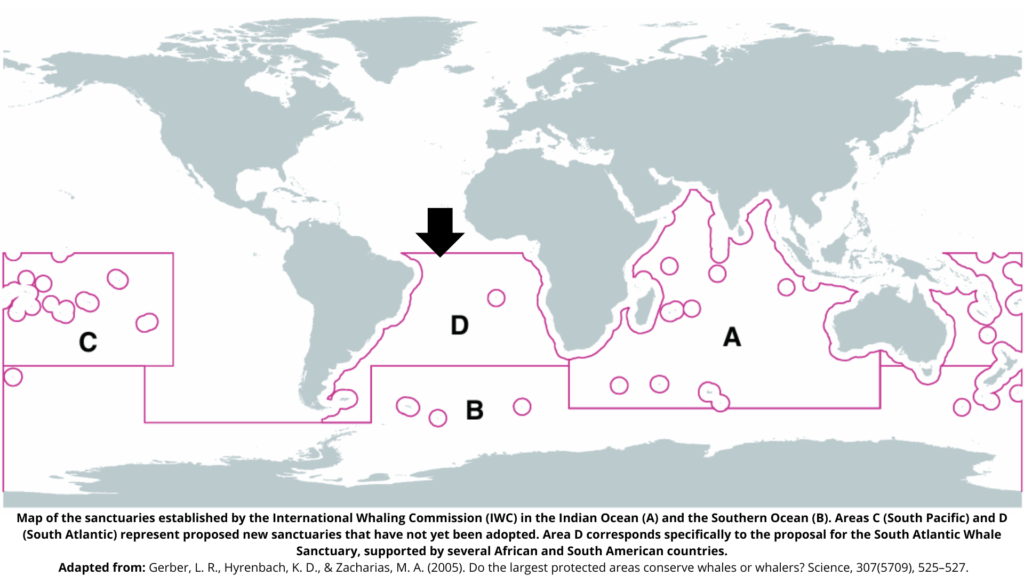
Since 2001, the nations of the Buenos Aires Group (Brazil, Argentina, Uruguay, South Africa, and Gabon since 2010) have advocated for the creation of a South Atlantic Whale Sanctuary (Marcondes, 2020). Its objective is clear: protect the full inter-hemispheric migrations of great whales, promote exclusively non-lethal research, and encourage the development of a sustainable blue economy.
Yet despite broad majority support, the proposal failed once again during the 69th session of the International Whaling Commission (IWC) in Peru in 2024, lacking the required qualified majority (IISD, 2024). Although the IWC Scientific Committee continues to recommend strengthened non-lethal approaches and enhanced regional cooperation for cetacean conservation, a persistent minority of pro-whaling countries continues to block the adoption of the South Atlantic Sanctuary—contradicting global trends and the state of scientific knowledge (IWC, 2023). However, as emphasized in the open letter signed by 110 African conservation experts, “no country in Central or West Africa practices commercial whaling, and their support for pro-whaling positions constitutes a direct contradiction of their own national conservation policies.” (www.gabonreview.com).
Aquatic Species NGO’s position: a firm commitment to the Sanctuary
Aquatic Species NGO reaffirms its strong support for the establishment of the South Atlantic Whale Sanctuary. Whale conservation lies at the core of our mission to protect threatened aquatic species in Gabon and the Gulf of Guinea. Our stance is based on three key principles:
- Commercial whaling is incompatible with conservation commitments (IUCN Red List, multiple threatened status listings).
- Non-lethal research provides robust and sufficient scientific data (Pastavrou & Ryan, 2023; IWC, 2023).
- Gabon has a major ecological and economic interest in supporting an international sanctuary.
Why Would This Sanctuary Be an Economic Engine for Gabon?
– Whale-watching: a global market exceeding USD 2.1 billion per year
Whale-watching generates over USD 2.1 billion annually, attracting nearly 13 million tourists worldwide (Cisneros-Montemayor et al., 2010). In South Africa, where whale-watching is a major component of marine tourism, primarily international visitors invest heavily in these excursions, confirming the growing economic importance of this sector for African economies (Geldenhuys et al., 2019).
Gabon hosts hundreds of humpback whales (Megaptera novaeangliae) each year between June and September (Strindberg et al., 2011; Chou et al., 2020). An internationally recognized sanctuary would: i) increase Gabon’s international visibility, ii) attract more international tourists, iii) stimulate local investment, iv) promote the creation of sustainable blue jobs.
– Unique Ecological Contribution: Whales Boost Marine Productivity
Whales stimulate the marine carbon pump by fertilizing surface waters through the “whale pump” (Roman & McCarthy, 2010). They enhance phytoplankton productivity, which directly benefits: artisanal fisheries, food security, the resilience of marine ecosystems.
In Gabon, where coastal communities depend heavily on marine resources, this contribution is particularly strategic. For many households, fishing is not merely an economic activity, it represents food security, cultural continuity, and social stability. As Franck, a fisher in Gabon, explains: “My family, and many people I know, depend directly on fishing. Thanks to the income from fish, we can pay for our children’s schooling, buy daily food, and cover essential needs. Without fishing, life would be very difficult.”
– Strengthening Gabon’s Environmental Diplomacy
As highlighted by Metcalfe et al. (2022), Gabon is emerging as a continental leader in marine conservation and environmental governance. Supporting the South Atlantic Whale Sanctuary would strengthen Gabon’s influence in international negotiations, consolidate its national “Blue Gabon” strategy, enhance its ability to mobilize multilateral conservation funding.
A new submission to the IWC: a decisive moment
Although the Sanctuary proposal was not adopted during the 2024 IWC session, it remains central to cetacean protection efforts in the region.
Aquatic Species NGO calls on:
- the Government of Gabon,
- national and international scientific institutions,
- African NGOs,
- and regional organizations,
to adopt a unified, clear, and strongly pro-conservation position to support the establishment of the South Atlantic Whale Sanctuary during upcoming international discussions.
Conclusion: what If this time we truly committed?
Whale conservation is not ecological nostalgia: it is a strategic investment in the future of African nations, including Gabon. The science is clear. The economics are favourable. African populations overwhelmingly support cetacean conservation. “Protecting whales means protecting the ocean. And protecting the ocean means protecting the future of our communities.” Aquatic Species NGO.
African countries stand to gain ecologically, socially, and economically by supporting the creation of the South Atlantic Whale Sanctuary. What if, this time, we truly decided to commit?
References
Scientific papers
Büscher, B. (2025). The great conservation tragedy? A critical reflection of (neo)protectionism in relation to the ‘30 × 30’ global biodiversity framework. The Journal of Peasant Studies, 52(3), 439–460. https://doi.org/10.1080/03066150.2024.2397373
Chou, E., Kershaw, F., Maxwell, S. M., Collins, T., Strindberg, S., & Rosenbaum, H. C. (2020). Distribution of breeding humpback whale habitats and overlap with cumulative anthropogenic impacts in the Eastern Tropical Atlantic. Diversity and Distributions, 26(5), 549–564. https://doi.org/10.1111/ddi.13033
Cisneros-Montemayor, A. M., Sumaila, U. R., Kaschner, K., & Pauly, D. (2010). The global potential for whale watching. Marine Policy, 34(6), 1273–1278. https://doi.org/10.1016/j.marpol.2010.05.005
Geldenhuys, L. L., Van der Merwe, P., & Saayman, M. (2019). Profile and behaviour of marine tourists in South Africa. African Journal of Hospitality, Tourism and Leisure, 8(4).
Gerber, L. R., Hyrenbach, K. D., & Zacharias, M. A. (2005). Do the largest protected areas conserve whales or whalers? Science, 307(5709), 525–527. https://doi.org/10.1126/science.1106120
Marcondes, D. (2020). Conservationist geopolitics: Brazilian foreign policy and the South Atlantic Whale Sanctuary. Marine Policy, 120, 104054. https://doi.org/10.1016/j.marpol.2020.104054
Roman, J., & McCarthy, J. (2010). The whale pump: Marine mammals enhance primary productivity. PLoS ONE, 5(10), e13255. https://doi.org/10.1371/journal.pone.0013255
Strindberg, S., Ersts, P. J., Collins, T., Sounguet, G.-P., & Rosenbaum, H. C. (2011). Line transect estimates of humpback whale (Megaptera novaeangliae) abundance and distribution on their wintering grounds in the coastal waters of Gabon. Journal of Cetacean Research and Management, Special Issue 3, 151–160.
Institutional Reports and Documents
Gabon Review. (2024). Lettre ouverte : L’Afrique se déshonore à encourager la chasse à la baleine à la Commission baleinière internationale (CBI). Article published 20 september 2024: www.gabonreview.com/lettre-ouverte-afrique-se-deshonore-a-encourage-la-chasse-a-la-baleine-a-la-commission-baleiniere-internationale-cbi/
International Institute for Sustainable Development (IISD). (2024). Summary of the 69th meeting of the International Whaling Commission: 23–27 September 2024. Earth Negotiations Bulletin, 34(3). https://enb.iisd.org/international-whaling-commission-iwc69
International Whaling Commission (IWC). (2023). Report of the Scientific Committee: Bled, Slovenia, 24 April–6 May 2023 (SC/69A). https://iwc.int
WWF. (2024). Rapport Planète Vivante 2024 – Un système en péril. WWF International.